Most traders and investors spend hours studying charts, reading market news, analysing companies and searching for the next opportunity.
But there is one thing many overlook:
They don’t spend enough time studying themselves.
You may know which stocks you traded last month. You may remember a few big wins and painful losses. But can you answer:
- Which trading setups actually work best for you?
- How much money are you making after charges?
- Are you exiting trades too early?
- Are your losses coming from your strategy—or from poor discipline?
- Which asset classes or strategies consistently perform better for you?
- How often are you taking trades because of FOMO?
- What mistakes do you keep repeating?
Without a proper record, these questions are difficult to answer objectively.
This is where a Trading & Investing Journal can make a difference.
Your Trading History Is Data. Start Using It.
Every trade contains information.
Your entry price, exit price, position size, capital deployed, profit or loss, charges, strategy, mindset and the reason behind the trade all tell a story.
But if that information is scattered across broker statements, screenshots, WhatsApp messages, notebooks or simply sitting in your memory, it becomes difficult to identify patterns.
A structured journal brings everything into one place.
Instead of simply asking:
“Did I make money today?”
you can start asking:
“What can my trades teach me about how I operate in the market?”
That shift—from tracking results to understanding behaviour—is what makes journaling powerful.
Introducing the Trading & Investing Master Journal
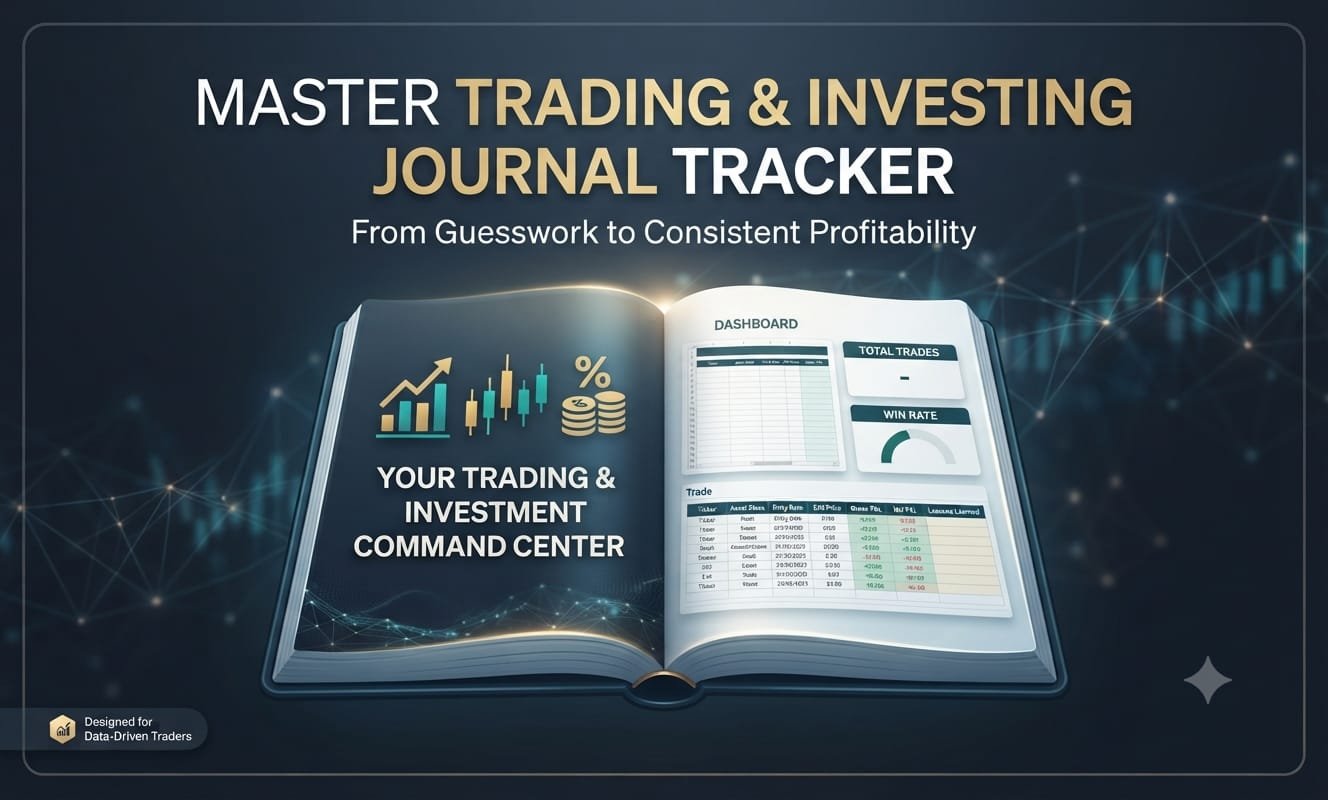
The Trading & Investing Master Journal is designed for traders and investors who want a structured way to record, analyse and reflect on their market activity.
It brings the key elements of a trade into one organised spreadsheet so that you can build a historical record of your decisions and performance.
Whether you’re an intraday trader, swing trader, positional trader or long-term investor, the journal gives you a framework to document your journey.
1. Plan Your Trade Before You Enter
Good trading isn’t only about what happens after you enter a position.
The decision-making process starts before the trade.
The journal allows you to record important information such as:
- Ticker / Asset
- Asset Class
- Type / Side
- Entry Price
- Quantity
- Capital Allocated
- Risk-Reward
- Strategy
- Mindset / Notes
This encourages you to think about why you are entering a position before the market gives you the opportunity to react emotionally.
Instead of:
“This stock is moving. I should probably enter.”
you can document:
“What is my setup? What is my risk? Why am I taking this trade?”
That small change can make your trading process more deliberate.
2. Know Your Actual P&L
A common mistake among traders is looking only at gross profit.
A trade may appear profitable, but brokerage, exchange charges, taxes and other transaction costs can reduce the actual return.
The journal accounts for Charges and calculates Net P&L, allowing you to look beyond the headline profit.
It also automatically calculates key figures such as:
- Capital Allocated
- Exit Value
- Gross P&L
- Return %
- Charges
- Net P&L
So instead of manually calculating every trade, the spreadsheet does much of the arithmetic for you.
You focus on the decision. The journal handles the calculations.
3. Track More Than Just Winning and Losing
A trader’s performance cannot be understood simply by counting winning trades.
Imagine you have two traders.
Trader A wins 7 out of 10 trades but repeatedly takes small profits and occasionally suffers large losses.
Trader B wins only 5 out of 10 trades but maintains disciplined risk management and allows profitable positions to develop.
The number of winning trades alone doesn’t tell the entire story.
That’s why the journal captures additional information around every trade.
You can record your:
Strategy → Risk-Reward → Position → Result → Mindset → Lesson
Over time, this creates a much more useful picture of your trading behaviour.
4. Discover Which Strategies Actually Work for You
Every trader eventually develops preferences.
Maybe you trade breakouts.
Maybe you prefer momentum.
Maybe you follow swing setups.
Maybe you’re a value investor.
Or perhaps you use several different approaches.
The problem is that traders often have an opinion about what works without having enough historical data to support that belief.
The journal allows you to record the strategy behind each trade.
Over time, you can filter your trading history by strategy and examine your results.
You may discover something surprising:
The strategy you enjoy trading isn’t necessarily the strategy where you perform best.
That is precisely the kind of insight a journal is designed to uncover.
5. Track Your Mindset, Not Just Your Money
Markets are numbers-driven, but trading is also deeply behavioural.
Fear.
Greed.
FOMO.
Overconfidence.
Impatience.
Revenge trading.
Hesitation.
These emotions can influence decisions just as much as a chart or financial statement.
The journal therefore includes a dedicated Mindset / Notes section.
Before or during a trade, you can record what you were thinking and why you took the position.
For example:
“Entered because the stock broke the day’s high.”
or:
“Was tempted to enter because the stock was moving rapidly.”
or:
“Entered according to my planned setup.”
These notes become particularly valuable when you review your trades later.
You can begin separating strategy-driven decisions from emotion-driven decisions.
6. Turn Every Trade Into a Learning Opportunity
A losing trade isn’t necessarily a bad trade.
A profitable trade isn’t necessarily a good trade.
What matters is understanding why the trade happened and what you can learn from it.
That’s why the journal includes a Lessons Learned section.
After closing a position, ask yourself:
- Did I follow my plan?
- Did I enter too early?
- Did I exit too early?
- Did I manage risk properly?
- Was the trade based on my strategy?
- Did emotions influence the decision?
- What would I do differently next time?
This creates an important feedback loop:
Trade → Review → Learn → Adjust → Trade Again
Instead of allowing mistakes to disappear into your trading history, you turn them into documented lessons.
7. Get a Quick View of Your Performance
The journal also provides a summary at the top of the sheet, including:
Total Trades | Win Rate | Total Net P&L
This gives you a quick snapshot of your recorded trading activity.
Rather than opening multiple broker reports or manually calculating your results, you have a central place to monitor your journal.
And because your individual trades are recorded underneath, you can move from the big picture to the details whenever you want.
8. Your Journal Becomes More Valuable Over Time
The biggest benefit of a trading journal isn’t necessarily visible after your first five trades.
It becomes more valuable as your database grows.
After 20 trades, you start seeing individual patterns.
After 50 trades, recurring behaviours may become clearer.
After 100+ trades, your journal can become a meaningful historical record of your trading decisions.
You can start asking questions such as:
Which strategies generate my strongest results?
Which setups produce my biggest losses?
Do I perform better in certain types of trades?
Am I consistently making the same mistake?
How often am I deviating from my original plan?
Your journal becomes a record of your own market behaviour.
Trading Is Not Just About Finding the Next Stock
There will always be another stock.
Another breakout.
Another IPO.
Another market rally.
Another opportunity.
But if you don’t understand your own decision-making process, constantly searching for the next opportunity may not solve the underlying problem.
Sometimes the most valuable information isn’t found on a chart.
It’s found in your own trading history.
A trading journal helps you step away from the noise and examine what you’re actually doing.
Who Is This Journal For?
The Trading & Investing Master Journal can be useful for:
📈 Intraday Traders
Track entries, exits, charges, strategies and trading behaviour across individual positions.
📊 Swing & Positional Traders
Document the reasoning behind trades and review how different setups perform over time.
💼 Investors
Maintain a structured record of investment decisions, capital allocation and performance.
🌱 Beginners
Develop the habit of documenting decisions from the beginning of their market journey.
🧠 Experienced Traders
Use historical data to identify recurring mistakes, behavioural patterns and areas for improvement.
Don’t Just Track Your Trades. Learn From Them.
The goal of a trading journal isn’t to predict the market.
It isn’t a magic formula.
It doesn’t guarantee profits.
And it certainly can’t replace research, risk management or independent decision-making.
Its purpose is simpler:
To help you become more aware of your own decisions.
Because every trade gives you two outcomes:
The financial result.
And the lesson.
Most traders record the first.
The Trading & Investing Master Journal is designed to help you capture both.
Your Next Trade Is an Opportunity to Learn.
Don’t let your trades become a list of forgotten transactions.
Record them.
Review them.
Understand them.
Learn from them.
And build a trading process based not only on what you think works—but on what your own trading history shows you.
Start journaling your trades and investments today.
Your market journey deserves a record. Your future decisions deserve the lessons from it.
If you’re looking for a structured Trading & Investing Journal prepared by us to help you track, analyse and reflect on your trades and investments, you can get in touch with us at contact@tickershorts.com. The complete journal is available for just ₹999—a simple, practical tool designed to help you build better trading and investing habits by learning from your own decisions and performance.